
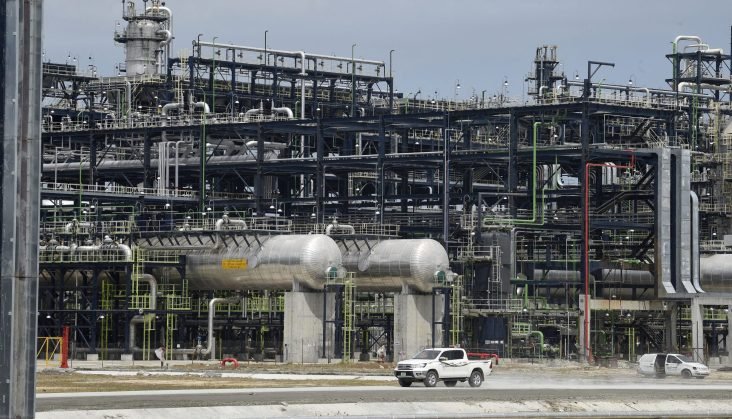
Dangote Refinery to drive Africa’s refining boom as OPEC projects 800,000 bpd capacity expansion by 2030
By Eyo Nsima
The Dangote Petroleum Refinery is expected to play a pivotal role in Africa’s refining renaissance, as the Organization of the Petroleum Exporting Countries (OPEC) projects that the continent will account for one of the world’s fastest-growing refining capacity expansions over the next five years.
According to OPEC’s latest medium-term outlook, Africa is expected to add about 800,000 barrels per day (bpd) of new refining capacity between 2026 and 2030, positioning the continent as the third-largest destination for refining investments globally, behind the Asia-Pacific and the Middle East.
The report estimates that global refining capacity additions during the period will total approximately 4.9 million bpd, with Asia-Pacific accounting for 2.8 million bpd, the Middle East contributing 1 million bpd, and Africa adding 0.8 million bpd. Collectively, these three regions will represent about 94 per cent of all global refining capacity additions through 2030.
For Nigeria, industry analysts say the Dangote Refinery is expected to account for a significant share of Africa’s refining growth, reinforcing the country’s ambition to become the continent’s leading petroleum products refining and export hub.
Dangote transforms Nigeria’s downstream sector
The emergence of the 650,000 bpd Dangote Refinery has already begun transforming Nigeria’s downstream petroleum industry.
For decades, Africa’s largest crude oil producer depended heavily on imported refined petroleum products despite abundant crude reserves. The commencement of large-scale refining operations at the Dangote facility has significantly reduced import dependence while improving domestic fuel availability and positioning Nigeria as a growing exporter of refined petroleum products.
The refinery is increasingly supplying petrol, diesel, aviation fuel and other petroleum products to Nigeria and several African markets, supporting regional energy security and reducing the continent’s reliance on imports from Europe, Asia and the Middle East.
Analysts believe the refinery also complements the rehabilitation of Nigeria’s state-owned refineries and ongoing private-sector investments, creating the foundation for a more resilient domestic refining industry.
Africa emerging as refining investment destination
OPEC noted that the concentration of refining investments in Africa reflects the region’s rising energy demand, expanding economies and growing need for value addition.
The projected 800,000 bpd increase in refining capacity is expected to strengthen Africa’s ability to process more of its own crude oil, reduce imports of refined fuels and improve energy security across the continent.
The investment wave is also expected to stimulate industrial development, create employment opportunities, enhance foreign exchange earnings through exports and deepen regional trade under the African Continental Free Trade Area (AfCFTA).
For Nigeria, the Dangote Refinery is widely seen as the flagship project driving this transformation.
Global refining market tightening
OPEC’s outlook also points to a tightening global refining market over the medium term.
The organization projects that the balance between new refining capacity and global demand will become tighter relative to 2025, resulting in higher refinery utilization rates worldwide.
Global refinery utilization is forecast to increase from 80.8 per cent in 2025 to approximately 82.7 per cent by 2030, indicating stronger demand for refining capacity despite the energy transition.
The projected increase suggests that modern, highly efficient refineries such as Dangote are likely to operate in a favourable market environment with sustained demand for refined petroleum products.
Higher utilization rates generally translate into improved refining economics, stronger margins and greater incentives for investment in efficient refining complexes.
Long-term opportunities remain strong
Beyond 2030, OPEC expects refining investments to continue, although at a gradually slower pace.
Global refining capacity additions between 2026 and 2050 are projected to reach 19.3 million bpd.
Capacity growth is expected to be distributed as follows:
2026–2030: 5.3 million bpd (including incremental “creep” capacity);
2030–2035: 6.3 million bpd, supported by rising demand in developing economies;
2035–2040: 3.9 million bpd;
2040–2045: 2.2 million bpd; and
2045–2050: 1.7 million bpd.
According to OPEC, the gradual slowdown reflects moderating global oil demand growth toward the end of the outlook period rather than an immediate decline in the importance of refining.
Strategic advantage for Nigeria
Energy experts say the projections reinforce the strategic importance of the Dangote Refinery to Nigeria’s long-term energy and economic agenda.
As one of the world’s largest single-train refineries, the facility is expected to strengthen Nigeria’s position as a leading supplier of refined petroleum products to West Africa, Central Africa and other international markets.
The refinery is also expected to reduce pressure on Nigeria’s foreign exchange reserves by replacing fuel imports, improve the country’s trade balance, encourage industrialization through the supply of petrochemical feedstocks and support the government’s broader objective of maximizing value from the nation’s crude oil resources.
With Africa set to account for one of the largest refining expansions globally over the next five years, the Dangote Refinery is emerging not only as a national asset but also as a cornerstone of the continent’s drive toward greater energy independence, industrialization and long-term energy security.