

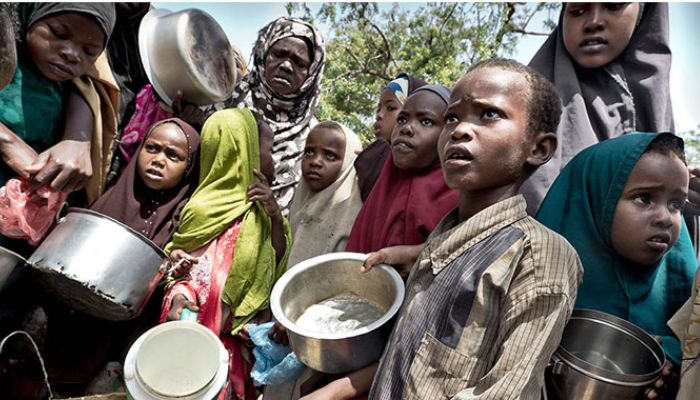
Nearly 164 million people across Africa are facing acute food insecurity, with persistent conflicts, rising food prices, economic shocks and adverse weather conditions worsening the continent’s food crisis.
The Africa Center for Strategic Studies disclosed this in a report released on November 4, 2026, warning that the number of Africans experiencing crisis-level hunger has remained above 160 million for the third consecutive year.
According to the report, approximately 134 million people, representing 80 per cent of those facing acute food insecurity, live in conflict-affected countries.
“Conflict continues to be the primary driver of acute food insecurity in Africa,” the report stated.
It noted that the number of Africans facing acute food insecurity has nearly tripled from 61 million in 2019, reflecting the devastating impact of prolonged conflicts, economic disruptions and declining household purchasing power.
Nigeria, the Democratic Republic of Congo (DRC), Sudan and Ethiopia account for approximately 60 per cent of the affected population, with each country recording between twofold and sevenfold increases in food insecurity since 2019.
Nigeria has 36.9 million people facing acute food insecurity, the highest figure on the continent, followed by the DRC with 26.5 million, Sudan with 19.5 million and Ethiopia with 15.8 million.
The report identified Nigeria as the country with the highest numerical increase over the past year, with an additional 6.3 million people, representing a 21 per cent rise, falling into acute food insecurity.
It attributed the deterioration to violence by Islamist militant groups in the North-East and organised criminal attacks in the North-West, which have displaced communities and forced households to abandon farming, pastoral and trading activities.
The report also raised concerns about famine conditions in parts of Sudan, South Sudan and Somalia, particularly in areas isolated by fighting. In Nigeria, approximately 10,300 people in Borno State, the epicentre of the Islamist insurgency, are also expected to experience famine.
Beyond these countries, the report identified widespread food insecurity across Africa, noting that more than 10 per cent of the population in 22 countries are affected, compared with only nine countries in 2019.
South Sudan has the highest proportion of its population facing acute food insecurity at 64 per cent, followed by Sudan at 38 per cent, the Central African Republic at 37 per cent and Somalia at 33 per cent.
The report also highlighted the effects of economic shocks, including disruptions associated with the COVID-19 pandemic and restrictions on maritime traffic, which have increased food production, transportation and import costs.
It disclosed that the Food and Agriculture Organisation’s average baseline measure of household food basket prices across Africa has increased by one-third since 2019.
Food inflation has also exceeded 15 per cent in six countries facing severe food crises since June 2026. These include Sudan, 52 per cent; South Sudan, 18 per cent; Libya, 18 per cent; Malawi, 18 per cent; Nigeria, 18 per cent; and Ethiopia, 15 per cent.
In Nigeria, rising agricultural input costs are further threatening food production, with farmers experiencing a 56 per cent increase in fuel and fertiliser costs over the past year.
The report warned that the increases could discourage farmers from participating in the forthcoming farming season, further undermining food availability and affordability.
It also identified severe El Niño conditions as an additional threat to food security in Nigeria, Chad, Cameroon, Somalia, Sudan, South Sudan and Ethiopia.
In Sudan, drought affecting more than half of the country has damaged agricultural land in North Darfur, South Darfur, West Kordofan and South Kordofan, worsening food shortages and reducing farmers’ incomes.
In Ethiopia, below-average rainfall has contributed to crop production losses of 40 per cent in East and West Hararghe, reducing household food supplies and agricultural earnings.
Similarly, severe flooding in Somalia could displace as many as 874,000 people, destroy crops and contaminate water sources. About two million people are already experiencing emergency levels of food insecurity, more than twice the number recorded last year.
In Southern Africa, although the proportion of people facing acute food insecurity is relatively lower at seven per cent, the report identified Mozambique, Malawi and Madagascar as countries facing significant challenges.
Madagascar recorded the continent’s highest percentage increase in acute food insecurity, at 96 per cent, following political instability, with 3.7 million people now affected.
The report stressed that addressing Africa’s food crisis requires tackling conflicts disrupting agricultural production and livelihoods, while strengthening resilience against economic shocks, rising input costs and climate-related disruptions.