
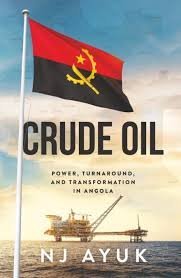
Crude Oil: Power, Turnaround and Transformation in Angola
Author: NJ Ayuk
Pagination: 225 pages
Publisher: Made for Success Publishing
Reviewer: Udeme Akpan
Crude Oil: Power, Turnaround and Transformation in Angola by NJ Ayuk clearly documents how Angola — a resource-rich nation bordered by Namibia, Zambia, the Democratic Republic of the Congo, and the Atlantic Ocean — deployed reforms to revive its economy, attract massive investment, and reposition itself as one of Africa’s leading oil and gas producers and exporters.
The research-driven book examines several major themes. First, it traces Angola’s history as an oil-producing nation and explains how crude oil shaped its politics, economy, and post-independence development. Second, it captures the decline and subsequent recovery of Angola’s petroleum sector following years of falling production, declining investments, and economic difficulties in the 2010s.
Third, the author highlights the reforms introduced under President João Lourenço, including the restructuring of Sonangol, the creation of the National Oil, Gas & Biofuels Agency, fiscal policy improvements, and measures designed to encourage foreign investment.
Fourth, the book underscores the importance of visionary leadership, regulatory clarity, and political stability in rebuilding investor confidence. Ayuk argues that Angola became a “masterclass” in energy-sector reform because it established predictable laws and investment-friendly policies.
Fifth, the book reflects on the tension between Africa’s development needs and growing global pressure for rapid energy transition. It strongly supports continued oil and gas development in Africa as a pathway to industrialization, energy security, and poverty reduction.
Sixth, it sheds light on Angola’s future prospects in exploration, refining, natural gas, and downstream petroleum development.
Seventh, the book contains important interviews and insights from Angolan policymakers and oil executives, alongside discussions of key reforms introduced from 2017 onward and analyses of how oil revenues influenced Angola’s conflicts, governance, and economic transformation.
Eighth, the treatment of the book follows a sequential order, enabling readers to trace events and developments from one stage of Angola’s economic evolution to another with clarity and ease.
Specifically, Chapter One is dedicated to the land, its people, and resources, while Chapters Two and Three examine Angola’s early colonial history and oil discovery, respectively. Chapters Four, Five, Six, and Seven focus on recent history, the new era under João Lourenço’s presidency, Diamantino Azevedo — the man behind the reforms — and Angola’s political reforms, respectively. Chapters Eight, Nine, Ten, and Eleven examine what Ayuk refers to as Angolan changemakers, the current outlook, natural gas evolution, and the future of renewable energy, critical minerals, and a just energy transition.
Generally, the book presents Angola as an example of how African countries can leverage oil and gas resources for economic growth when natural endowment is combined with strong institutions, reforms, and investor-friendly policies. Ayuk’s broader message is that Africa should shape its own energy future rather than succumb to external pressure to abandon fossil fuels prematurely.
Judging from the author’s stated intention, the book can be considered a remarkable success. Ayuk approaches the subject with humility, describing himself “not as an expert but as a student of Angola,” a role he says he intends to uphold throughout his life. This perspective gives the work a reflective and respectful tone, allowing readers to engage with Angola’s oil industry, political evolution and economic transformation through the eyes of a keen learner rather than a detached commentator.
As Chairman of the African Energy Chamber, organisers of the African Energy Week held annually in Cape Town — an event I have attended several times, not only as the Energy Editor of a national daily newspaper but also as President of the African Association of Energy Journalists and Publishers (AJERAP) — Ayuk has remained passionate about promoting investment across Africa’s energy sector. This background strengthens his credibility in undertaking such a detailed study of Angola’s transformation.
The title — Crude Oil: Power, Turnaround and Transformation in Angola — is both compelling and memorable, capable of attracting attention now and in the future. Equally noteworthy is Ayuk’s deliberate avoidance of excessive industry jargon. By relying largely on accessible language, he improves the book’s readability and broadens its appeal beyond oil and gas professionals.
Another strength lies in the book’s manageable size. At 225 pages and 11 chapters, it is concise enough to sustain reader interest while remaining comprehensive in its treatment of Angola’s petroleum evolution.
The timing of the publication is also significant. African nations are currently grappling with energy poverty, energy security challenges, and the demands of sustainable development amid the global energy transition debate. Against this backdrop, the book demonstrates what Angola has achieved through leadership, resilience, reforms, and strategic focus.
Importantly, the book carries a broader message for governments and citizens across Africa. It emphasizes that natural resource endowment alone is insufficient unless countries invest wisely and transform those resources into lasting wealth. For policymakers, it reinforces the importance of political stability, transparent regulation, accountability, and investment incentives in attracting both local and foreign capital.
Ayuk further argues that African countries should harness their resources for development without being rushed into abandoning hydrocarbons. In his view, a just energy transition remains the most practical option for Angola and other African nations seeking to provide energy access to the more than 600 million Africans still without electricity.
Ultimately, this pioneering work is likely to stimulate further debate, scholarship, and investment interest aimed at enhancing energy security and sustainable development not only in Angola but across the African continent.
*** Udeme Akpan is President of the African Association of Energy Journalists and Publishers (AJERAP).