
ENERGY TRANSITION: IOCs shift to gas as environmentalists, others battle against fossil fuel
By Eyo Nsima
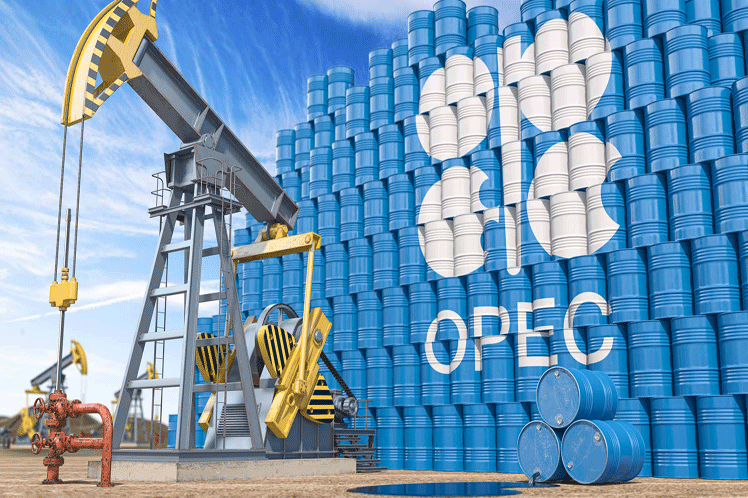
The International Oil Companies, IOCs, have started shifting toward gas as environmentalists and others battle against fossil fuel production and consumption, according to African Energy Chamber, AEC.
In its latest report, ‘The State of African Energy 2022’, obtained by The Daily (www.thedaily-ng.com), AEC, stated: “The shift away from crude oil is influenced by historical regulatory challenges and the growing influence of stakeholders in shaping future strategy, related to the heavily publicized shift away from less clean fossil fuels.
“The shift is in line with current M&A activity, as oil fields are offloaded in favour of gas fields. Further justification for such as shift can be observed in the fact that natural gas accounts
for more than 75% of the hydrocarbons discovered in Africa over the last 10 years.
“This puts Africa as a gas-driven industry, where said monetization can cause socio-economic growth, allowing for a reduction of energy imports, and greater access to electricity. Overall Figure 3.3 projects that for crude oil, the Major’s contribution from 2015 – 2025 falls from 33% to 26%, whilst gas production rises from 28% to 31%.”
It also stated: “With the European governments imposing binding emission targets, and the European Investment Bank announcing an end to investment in African oil and gas, the majors follow their footsteps. In addition, organizations such as Greenpeace and Friends of the Earth continue to cause project disruptions in Africa, impacting potential opportunities for sectoral and economic growth. These organizations commonly protest outside oil refineries, or events hosted by large oil producers (e.g., Shell in 2018, Johannesburg in 2021). This coupled with the fluctuating oil prices amidst the global pandemic, and the uncertain future of fossil fuels, is causing gradual divestment away for crude oil amongst the majors.
“On the other hand, natural gas is central for the transition that Africa needs to power and progress sectoral development with employment in new forms. Italy-headquartered ENI is in discussions with advisers to offload a set of its operated assets in Congo, following the dip in oil prices. ENI also sold a production sharing contract (PSC) to SNPC (Congo), with projections that an overall drop in production of 33% will occur in the coming decade. Similarly, ExxonMobil recently pulled out of a deep-water oil prospect offshore Ghana.”
Further, it maintained that, “ Shell, meanwhile, will offload the last of its Nigerian assets to move towards cleaner energy, and avoid litigation arising from oil spills. Its divestment could deal a fresh blow to the fiscal plans of the Nigerian government, where about 90% of revenue comes from oil, as it rebalances from the oil crash of 2020. Shell is currently under examination by the Dutch court, which announced that it must reduce its greenhouse gas emissions by 45% by 2030.
“Low investment levels threaten currently producing oil fields in Angola, which face a sharp decline in production as fields mature, threatening the nation’s ability to meet Opec+ allowances. In the past, the African market presented challenges due to policies that barricade entry into the market, with high tariffs, and political tension. As of late, there has been a drive for amended policies, restructured regulatory frameworks and investor attractive initiatives, making it easier to do business.
“This restructuring has been led by Nigeria, the Republic of Congo, Angola, and Senegal. Unfortunately, the majors have lowered their view of investment prospects despite it being easier, with the current shift towards LNG being the main driver behind M&A activity. Ultimately, the majors may be looking to monetize the gas in the form of LNG. One example is Shell, TotalEnergies and Eni selling 45% interest in OML 17, valued at $1.1 billion. The large onshore license consists of 15 oil and gas fields, allowing the majors to pivot their investments to assets offshore the nation.
“The CEO of TotalEnergies in Nigeria – Mike Sangster – tells The Africa Report that going forward, the company is focusing more on gas and oil projects with a ‘low break-even point’. This could shift focus toward gas production, as stated by chairman and CEO of Total, Patrick Pouyanné, claiming it as the “transition energy”. The independents operating in Africa, including APA Cooperation, ConocoPhillips and Perenco, showcase transitioning, like the majors. Cairn Energy, recently sold its Sangomar assets to Woodside Petroleum, previously being sold to Lukoil. This should allow Woodside Petroleum to start production in Africa in 2024. However, despite this, the independents’ productive outlook in Africa for oil and gas is similar to the majors. Production is expected to decrease slightly in 2022, followed by a gradual but consistent decrease in the coming years. With majors selling large crude oil assets in Nigeria, Angola, Algeria, and Ghana, despite there being the large potential for growth, NOCs and INOCs are acquiring the largest proportion”
Click the link below to read the full report
https://energychamber.org/wp-